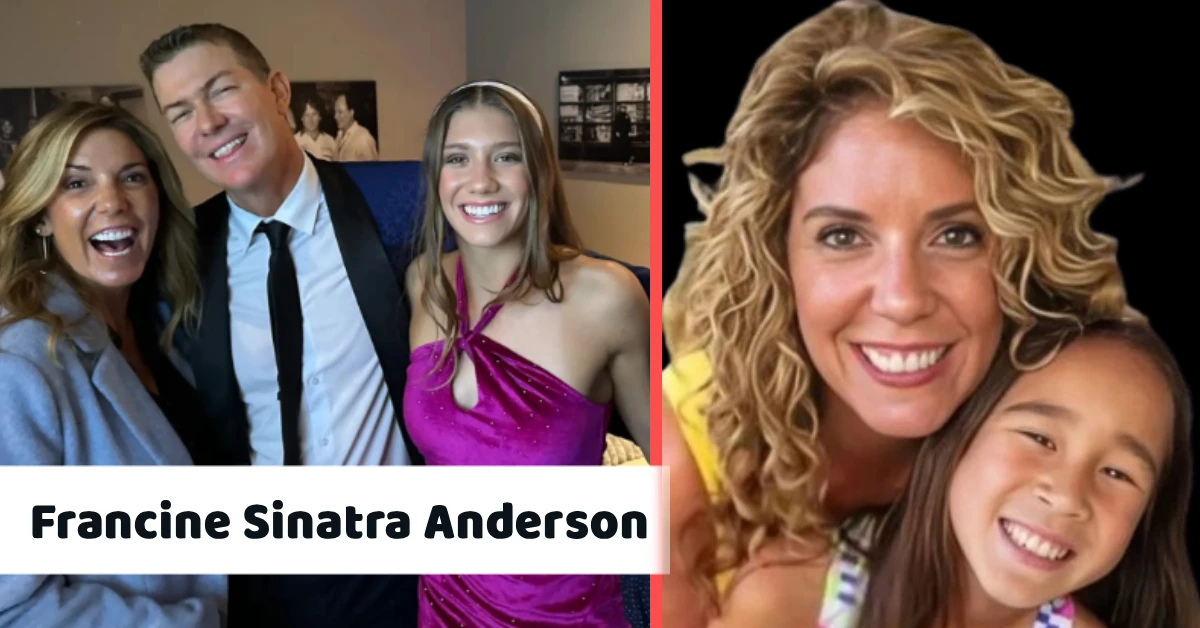
In an era where celebrity children monetize their family names on Instagram and TikTok, one woman connected to America’s most famous musical dynasty has spent five decades doing the exact opposite. Francine Sinatra Anderson, the eldest daughter of Frank Sinatra Jr., was born into fame but chose complete invisibility instead.
Francine Sinatra Anderson is the 52-year-old eldest daughter of Frank Sinatra Jr. and Mary Wallner. Born on November 16, 1972, she is the granddaughter of legendary crooner Frank Sinatra. Unlike most celebrity offspring, Francine has maintained complete anonymity throughout her life, avoiding public appearances, media interviews, and social media entirely.
Her story is remarkable not for what she did with the Sinatra name, but for what she deliberately avoided.
Francine was born during a four-year relationship between Frank Sinatra Jr. and Mary Wallner in the early 1970s. Her mother had connections to The Brady Bunch television show, linking Francine to two prominent entertainment families.
Despite this pedigree, Francine’s childhood was marked by her father’s absence. Frank Jr. provided financial support but refused to publicly acknowledge her as his daughter. This pattern would define their relationship throughout his life.
Mary Wallner took matters into her own hands. She wrote directly to Frank Sinatra Sr. to inform him about his granddaughter. “I wrote to Frank Sr and told him I didn’t want anything from him. I wanted him to know about Francine,” Wallner later revealed. Frank Jr. was reportedly furious about this direct communication, suggesting he had deliberately kept Francine’s existence secret from his own father.
Thanks to Mary’s persistence, Francine did attend some Sinatra family gatherings, though these connections remained minimal.
Frank Sinatra Jr.’s relationship with Francine was complicated and distant. While he paid child support, he never publicly claimed her as his daughter. In a 2012 Guardian interview, he dismissed questions about his other children, saying there were “certain people who make all sorts of claims.”
When Frank Jr. died of cardiac arrest in March 2016 in Daytona Beach, Florida, his obituary mentioned only one child: Michael Francis Sinatra. Francine and her other half-siblings were completely excluded. This final public rejection reflected a pattern that had lasted her entire life.
The reasons for Frank Jr.’s behavior appear rooted in fear of his father’s disapproval and concerns about inheritance. According to Mary Fleming, mother of another of Frank Jr.’s children, he lived in constant fear that his father would disinherit him if he discovered these relationships.
Francine is not an only child. Frank Sinatra Jr. had four children with four different women, creating a complex family tree.
Her half-siblings include Natalie Oglesby Skalla (born 1976), Francis Wayne Sinatra Jr. (born 1977), and Michael Francis Sinatra (born 1987). The age gap between Francine and her youngest half-brother, Michael, is 15 years.
In a bizarre coincidence, three of the four mothers were named Mary. Court documents from a 1995 child support case revealed that Natalie was “deliberately conceived” at a Holiday Inn near Chicago’s O’Hare Airport in November 1976. Her mother kept the hotel receipt with a note reading, “The weekend we made Natalie.”
The mothers of Frank Jr.’s children developed an unusual bond. Mary Wallner and Mary Fleming reportedly became friends and even lived together briefly. Francis Wayne Sinatra later admitted he had no idea if his other siblings existed while growing up.
Despite sharing a father, the siblings had little connection during their childhoods. Whether Francine maintains relationships with them today remains unknown.
Francine Sinatra Anderson has built her entire adult life around privacy. At 52, she has successfully avoided public scrutiny for over five decades.
She maintains no verified social media presence. Her Facebook account is empty, and her Instagram is private. When Daily Mail journalists attempted to contact her after her father died in 2016, she refused interviews and didn’t return phone calls.
Nothing is publicly known about her career, marriage (though her surname suggests she married), or whether she has children. She has never entered the entertainment industry or launched any known business ventures.
This level of anonymity requires active effort. In the digital age, staying completely invisible while connected to one of the most famous names in American music demonstrates a serious commitment to privacy.
Her decision stands in stark contrast to many celebrity descendants who leverage their family connections for careers, social media followings, or public platforms. Francine represents a conscious choice to define herself independently of the Sinatra legacy.
To understand Francine’s choice, you must understand the weight of the Sinatra name.
Her grandfather, Frank Sinatra, was more than a singer. He was a cultural phenomenon who dominated American music for five decades, won multiple Grammy Awards and an Academy Award, and became one of the best-selling musical artists of all time.
But the Sinatra legacy also included trauma. In 1963, nine years before Francine was born, Frank Jr. was kidnapped from Harrah’s Lake Tahoe and held for ransom. The kidnappers, Barry Keenan, Johnny Irwin, and Joe Amsler, demanded $240,000 (Frank Sr. had offered $1 million, but they declined). Frank Jr. was released after two days, and all three kidnappers were eventually captured.
This traumatic event had lasting effects on the family. Frank Sr. carried 10 dimes in his pocket for the rest of his life as a reminder of the payphone calls with the kidnappers. He was even buried with those dimes. The kidnapping created a family culture of wariness about publicity and personal safety that likely influenced Francine’s approach to her own life.
Growing up during the rise of tabloid journalism in the 1970s and 1980s, Francine witnessed the increasing invasion of celebrity privacy. Her Scorpio personality may have reinforced her natural inclination toward secrecy.
As of 2025, Francine Sinatra Anderson continues living privately, with no public details about her current residence or daily life. She does not attend events connected to the Sinatra family, does not give interviews, and does not post online.
She was excluded from both Frank Sinatra Sr.’s and Frank Jr.’s estates due to “born in wedlock” restrictions in their wills. Mary Wallner indicated they might challenge these provisions in court, though no public records confirm any legal action was taken.
Her commitment to anonymity has only increased public curiosity, making her one of the most mysterious figures connected to the Sinatra name. Yet for Francine, this mystery appears to be exactly what she wants.
Her story raises important questions about family responsibility, the right to personal privacy, and what we owe to legacies we inherit. While the Sinatra musical dynasty continues through other family members, Francine has found a way to live authentically separate from that legacy.
In an age obsessed with fame and visibility, her choice represents quiet resistance to expectations typically placed on celebrity offspring. She has successfully kept details of her life private and defined herself independently of her family name.
Francine Sinatra Anderson proves you can be connected to one of America’s most famous families and still choose complete invisibility. Her five decades of media silence is remarkable given her family’s fame. While public curiosity remains about her experiences, Francine’s unwavering anonymity suggests she has found peace in her decision.
Her story reminds us that not everyone wants fame, even when it’s handed to them through inheritance. Sometimes the most powerful choice is simply to walk away.