
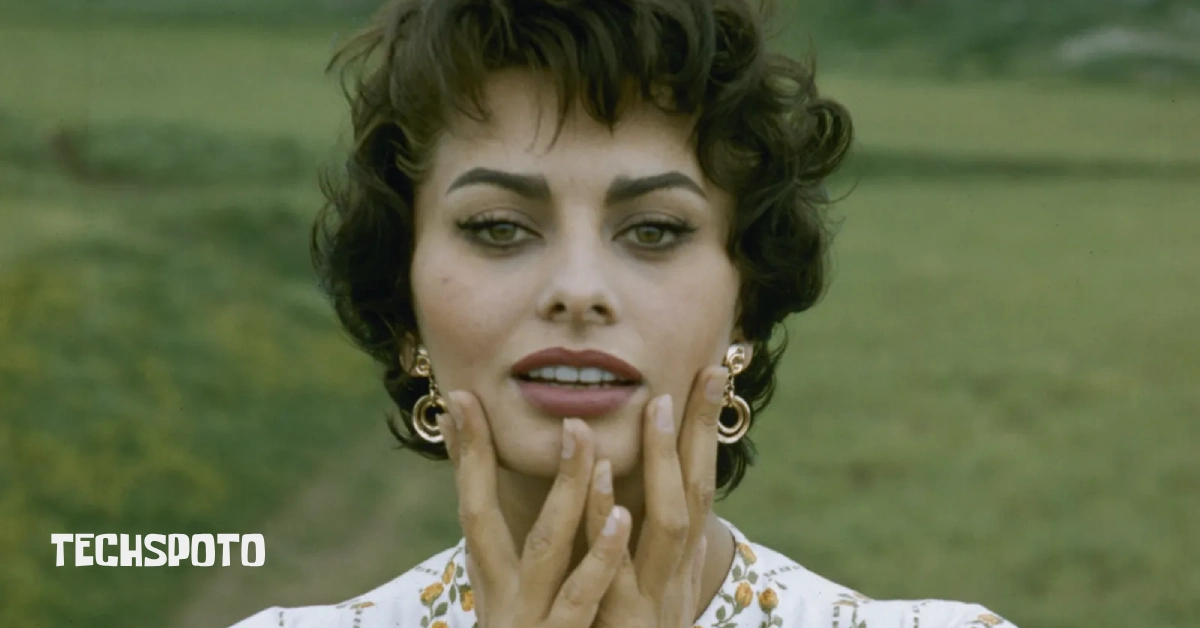
Sophia Loren rose from poverty in war-torn Pozzuoli to become one of cinema’s greatest stars. The Italian actress made history in 1962 as the first performer to win an Oscar for a non-English role, earning the Academy Award for Two Women.
Born Into Hardship in Pozzuoli
Sofia Scicolone was born on September 20, 1934, in Rome, but grew up in Pozzuoli, a small town near Naples that offered no glitz or glamor. Her early years were marked by constant struggle. Her father, Riccardo Scicolone, refused to marry her mother, Romilda Villani, and provided no financial support for Sofia and her younger sister Maria.
World War II made an already difficult situation worse. Pozzuoli’s harbor and munitions plants became frequent targets for Allied bombing. During one air raid, young Sofia was struck by shrapnel, leaving a permanent scar on her chin. The family often went without food or shelter.
Cinema became Sofia’s escape. She would seek refuge in movie houses during air raids, watching Rita Hayworth and Greta Garbo on screen. These images planted a seed—if they could transform themselves into stars, maybe she could too.
The Beauty Pageant That Changed Everything
At 15, Sofia entered the Miss Italia 1950 beauty pageant wearing a dress her grandmother made from taffeta curtains. She placed among the finalists and won the title of Miss Elegance, earning 23,000 lire and a train ticket to Rome.
That ticket became her passage to a new life. Sofia and her mother moved to Rome, hoping to find work at Cinecittà, Italy’s film capital. There, she caught the attention of Carlo Ponti, a film producer 22 years her senior.
Early auditions brought brutal criticism. Cameramen told her to consider plastic surgery—her nose was too long, her mouth too wide. Years later, she reflected on these rejections with characteristic strength: “Beauty is not important—you have to be interesting. I’ve never been beautiful. I’ve never been a china doll.”
She refused to change. In her memoir Yesterday, Today, Tomorrow: My Life, she wrote: “I knew perfectly well that my beauty was the result of a lot of irregularities all blended in one face, my face. Whether I won or lost, it was going to be in the original version.”
Breaking Through in Italian Cinema
Ponti saw potential where others saw flaws. He suggested a name change to Sophia Loren—a twist on Swedish actress Märta Torén’s name—and guided her through early roles. She appeared in several small films before landing her first starring role in Aida (1953).
Her breakthrough came with The Gold of Naples (1954), directed by Vittorio De Sica. The film featured a now-famous long tracking shot of Loren walking through a village street, her presence undeniable. De Sica called her “the essential Italian woman” and would become one of her most important collaborators.
By 1956, Loren had signed a five-picture contract with Paramount Pictures, launching her international career. She appeared opposite Hollywood’s biggest leading men—Cary Grant in Houseboat, Clark Gable in It Started in Naples, Frank Sinatra in The Pride and the Passion.
Two Women and Oscar History
In 1960, Loren reunited with De Sica for Two Women (La Ciociara). She played Cesira, a widowed mother desperately trying to protect her 12-year-old daughter in war-torn Italy. The role required Loren to draw from her own childhood experiences of war, poverty, and survival.
Originally cast as the daughter, Loren fought to play the mother instead. She was 26 years old.
The performance earned her 22 international awards, including the Cannes Film Festival’s best performance prize. In 1962, she won the Academy Award for Best Actress—the first major Oscar ever awarded for a non-English-language performance.
Loren didn’t attend the ceremony, citing fear of fainting from emotion. The next day, Cary Grant called her in Rome to deliver the news.
Hollywood Stardom and Major Films
The 1960s established Loren as one of the world’s most popular actresses. In 1961 and 1964, she received $1 million to appear in El Cid and The Fall of the Roman Empire—astronomical sums for the era.
She earned a second Oscar nomination for Marriage Italian Style (1964), another collaboration with De Sica and co-star Marcello Mastroianni. The duo became one of cinema’s most beloved pairings, appearing together in films like Yesterday, Today and Tomorrow (1963), which won the Oscar for Best Foreign Film.
Other notable performances included Arabesque (1966) with Gregory Peck, and A Special Day (1977) with Mastroianni, which earned critical acclaim for its mature, nuanced portrayal of two isolated souls.
Throughout this period, Loren received four Golden Globe Awards between 1964 and 1977 as “World Film Favorite – Female.”
Marriage to Carlo Ponti
Loren married Carlo Ponti in 1957 through a proxy ceremony in Mexico. Italian law didn’t permit divorce at the time, and Ponti was still married. The couple faced bigamy charges and had their marriage annulled in 1962, though they continued living together.
In 1965, they became French citizens, allowing Ponti to divorce his first wife and remarry Loren legally. Despite the complications and their 22-year age gap, the marriage lasted 50 years until Ponti died in 2007. Loren has described him as the love of her life.
They had two sons—Carlo Jr., born in 1968, and Edoardo, born in 1973. After becoming a mother, Loren deliberately reduced her film appearances during the 1970s and 1980s, choosing to focus on raising her children.
Awards and Recognition
Loren holds the record for most David di Donatello Awards for Best Actress, with seven wins spanning from Two Women (1960) to The Life Ahead (2020).
In 1991, she received an Academy Honorary Award “for her genuine treasures of world cinema who, in a career rich with memorable performances, has added permanent luster to our art form.”
Additional honors include five special Golden Globes (including the Cecil B. DeMille Award), a BAFTA Award, a Grammy Award, and the Volpi Cup for Best Actress at the Venice Film Festival. In 1999, the American Film Institute named her among the 25 greatest female screen legends in American film history.
Recent Work and Lasting Impact
After decades of selective roles, Loren returned to feature films in The Life Ahead (2020), directed by her son Edoardo Ponti. At 86, she played a Holocaust survivor with the same intensity she brought to her early roles.
Her career spans over 70 years and includes more than 100 films. She remains one of the last surviving major stars from the Golden Age of Hollywood.
At 90, Loren has dismissed retirement rumors, expressing hopes to star in new productions. She splits her time between Geneva, Switzerland, and visits with her family, which now includes four grandchildren.
Her impact extends beyond statistics and awards. Loren proved that beauty comes in many forms, that strength can coexist with femininity, and that a girl from war-torn Pozzuoli could conquer Hollywood without losing herself. She consistently chose roles portraying women with strong characters because, as she once said, it takes one to play one.
From the ruins of World War II to the heights of international cinema, Sophia Loren’s story is one of resilience, talent, and the refusal to be anything other than herself—irregularities and all.