
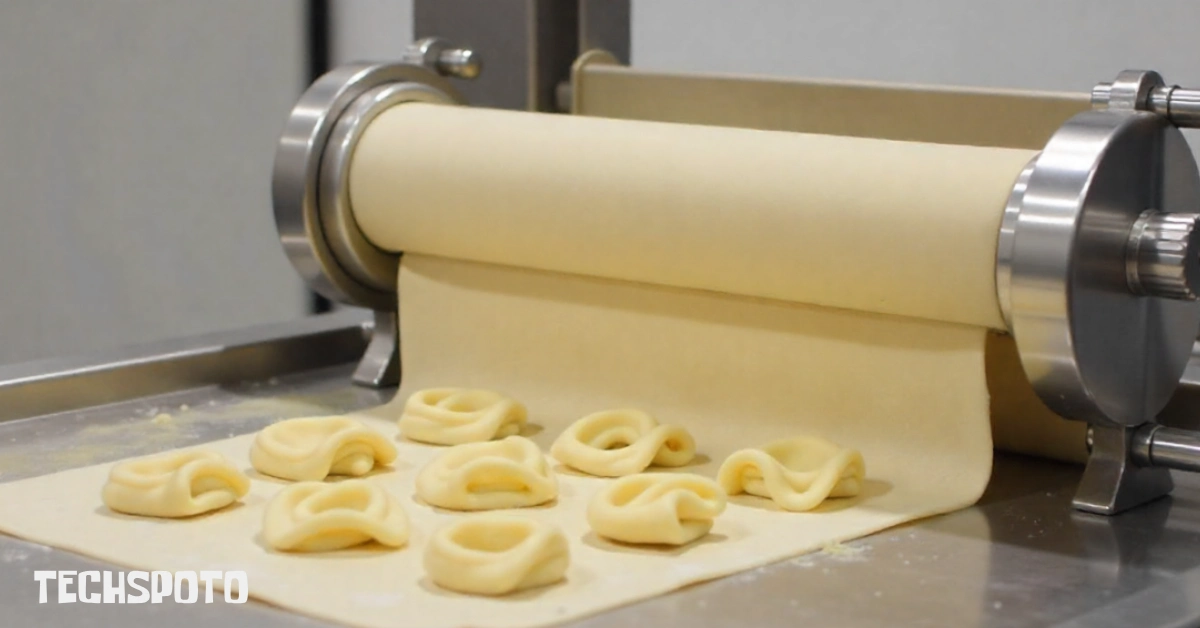
A tortellinatrice is a specialized pasta machine designed to automate tortellini production. It rolls dough, injects filling, and shapes each piece into the signature ring form—producing hundreds to thousands per hour while maintaining artisanal quality. Available in manual, semi-automatic, and industrial models for different production scales.
Picture an Italian nonna spending three hours hand-folding tortellini for Sunday dinner. Now imagine a machine replicating that same craftsmanship in minutes, piece by perfect piece. That’s the tortellinatrice—a device that has revolutionized pasta making without erasing centuries of tradition. Whether you’re running a restaurant kitchen, launching a pasta business, or simply passionate about authentic Italian cooking, understanding this machine opens new culinary possibilities.
What Is a Tortellinatrice?
The word “tortellinatrice” combines tortellini (the ring-shaped stuffed pasta) with -trice, an Italian suffix meaning “machine that performs.” Born in Italy’s Emilia-Romagna region—the birthplace of tortellini—these machines emerged in the mid-20th century when pasta demand outpaced handcrafted supply.
At its core, a tortellinatrice automates the most labor-intensive step: transforming flat dough and filling it into perfectly shaped, sealed tortellini. What once required skilled hands and hours of repetitive folding now happens through precision engineering. The machine doesn’t replace tradition—it scales it.
Modern tortellini machines range from compact tabletop units for home enthusiasts to industrial systems producing 3,000 pieces per hour. All share the same goal: consistent, authentic tortellini without the physical strain of manual production.
How a Tortellinatrice Works
The process mirrors handmade techniques but accelerates every step through mechanical precision:
- Dough Sheeting: Rollers flatten pasta dough to exact thickness specifications—typically 0.8 to 1.2 millimeters. Advanced models adjust pressure automatically based on dough consistency, preventing tears or uneven sheets.
- Filling Injection: A dosing system deposits precise amounts of filling onto the dough. High-end machines use dual-chamber injectors, allowing two-flavor combinations in a single production run. The dosage remains consistent to within grams, eliminating the guesswork of manual portioning.
- Cutting and Shaping: Rotary cutters slice the dough into squares while forming molds. Fold each piece around the filling. The signature tortellini ring takes shape as mechanical arms press corners together, mimicking the twist a skilled artisan performs by hand.
- Sealing Process: Pressure and sometimes moisture create an airtight seal. Properly sealed tortellini won’t burst during cooking—a quality marker machines achieve with 99% consistency compared to variable hand-sealing results.
Smart features in newer models include torque-balancing systems that detect dough stiffness and adjust roller pressure in real time. Humidity sensors prevent cracking during shaping. These innovations explain why machine-made tortellini increasingly rivals handcrafted quality in blind taste tests.
Types of Tortellini Machines
Choosing the right tortellinatrice depends on your production volume, budget, and quality standards. Three main categories serve different needs:
Manual Tortellinatrice
Best suited for home cooks, cooking schools, and small artisan shops where production stays under 100 pieces per hour. These machines require hand-cranking to roll dough and manual feeding of filling, but they automate the shaping step—the most technically difficult part of tortellini making.
Production capacity: 50-100 pieces/hour
Price range: $300-$800
Ideal for: Learning traditional techniques with mechanical assistance
Semi-Automatic Models
The middle ground between craft and commerce. Small restaurants and boutique pasta shops favor these machines because they balance automation with recipe flexibility. Operators control dough feeding and filling placement, while motors handle rolling, cutting, and shaping.
Production capacity: 200-600 pieces/hour
Price range: $2,000-$8,000
Ideal for: Businesses serving 30-100 daily portions of fresh tortellini
Industrial Tortellinatrice
Designed for mass production facilities supplying grocery stores, frozen food lines, and large-scale catering. These systems integrate with conveyor belts and require minimal human intervention beyond monitoring and ingredient refilling. Built with 316-grade stainless steel for decades of continuous operation.
Production capacity: 1,500-3,000+ pieces/hour
Price range: $15,000-$50,000+
Ideal for: Manufacturers producing 500+ kilograms of tortellini weekly
| Feature | Manual | Semi-Automatic | Industrial |
|---|---|---|---|
| Output/hour | 50-100 | 200-600 | 1,500-3,000+ |
| Power | Hand-cranked | Electric motor | 3-phase industrial |
| Operators | 1-2 | 1 | 1 + monitors |
| Footprint | Tabletop (2 sq ft) | Counter unit (4 sq ft) | Floor system (20+ sq ft) |
| Maintenance | Low | Moderate | High/professional |
| Best Use | Home/learning | Small business | Mass production |
Key Benefits of Using a Tortellinatrice
Time savings represent the most obvious advantage, but modern machines deliver value beyond speed.
- Efficiency Multiplier: A skilled artisan produces 30-40 tortellini per hour by hand. Even a basic semi-automatic tortellinatrice multiplies that by 10-15 times. For restaurants offering fresh pasta specials, this means preparing daily batches in 30 minutes instead of half a shift.
- Unwavering Consistency: Each tortellino emerges with identical dimensions, weight, and filling distribution. This uniformity ensures even cooking—no undercooked thick spots or burst thin sections. It also matters for portioning and pricing in commercial settings.
- Labor Cost Reduction: A tortellini maker doesn’t eliminate skilled workers; it redirects them. Instead of repetitive folding, staff focus on recipe development, quality control, and customer-facing activities. Labor hours per kilogram of tortellini can drop by 60-80%.
- Scalability Without Quality Loss: As orders increase, handmade production hits physical limits. Tortellinatrici scale linearly—double production time, double output. This allows businesses to grow revenue without compromising the product that built their reputation.
- Preservation of Technique: Counterintuitively, machines help preserve tradition by making fresh tortellini economically viable. Without automation, most restaurants would serve frozen industrial products. The tortellinatrice enables small producers to compete on freshness while maintaining authentic recipes passed down through generations.
Choosing the Right Tortellinatrice for Your Needs
Smart selection starts with an honest assessment of five factors:
- Production Volume: Calculate weekly tortellini demand, then add 30% buffer for growth and special events. Match machine capacity to peak demand, not average. Running at 60-70% capacity extends equipment life and maintains quality during rushes.
- Space Requirements: Measure available counter or floor space, accounting for ingredient staging areas and operator movement. Manual models need 2-3 square feet; industrial systems require 20-30 square feet plus access for cleaning.
- Power Infrastructure: Home models run on standard 110V outlets. Semi-automatic machines often need 220V circuits. Industrial units require 3-phase power and dedicated electrical panels. Confirm your facility’s electrical capacity before purchasing.
- Budget Reality: Initial purchase price represents 40-60% of total ownership cost over five years. Factor in maintenance contracts, replacement parts (cutting molds wear fastest), and potential electrical upgrades. Financing options exist for commercial equipment.
- Filling Versatility: Not all tortellini handle thick, chunky fillings equally well. If your recipes include coarse-ground meats or large vegetable pieces, verify the injector nozzle diameter. Standard nozzles accommodate smooth fillings like ricotta blends; industrial models offer interchangeable nozzles for textured mixtures.
A family-run trattoria serving 40 covers per night needs different equipment than a meal-kit company shipping 5,000 portions weekly. Match the machine to your business model, not aspirations. You can always upgrade as demand grows.
Maintenance and Care Essentials
Proper maintenance separates a decade of reliable service from three years of frustration.
- Daily Cleaning Protocol: Disassemble all dough-contact surfaces immediately after production. Dried pasta residue hardens like concrete within hours. Soak removable parts in warm water with mild detergent for 10 minutes, then scrub with non-abrasive brushes. Stainless steel components can go through commercial dishwashers if the dimensions allow.
- Weekly Deep Clean: Remove and inspect cutting molds for dough buildup in crevices. Check filling injector nozzles for clogs. Wipe down motor housings and electrical panels with damp cloths—never spray water directly on electrical components.
- Monthly Calibration: Test dough thickness consistency across the sheet width. Uneven rolling indicates roller misalignment, which causes tearing and irregular shapes. Most machines include adjustment screws for fine-tuning. Some advanced models self-calibrate via software.
- Quarterly Lubrication: Apply food-grade lubricant to all moving parts following manufacturer specifications. Over-lubrication attracts dough particles; under-lubrication causes premature wear. The sweet spot is a thin, even coat at all contact points.
Common Issues and Fixes:
- Dough tears during rolling: Reduce roller pressure or let dough rest 5 minutes longer before processing.
- Filling leaks during sealing: Decrease filling dosage by 10-15% or increase seal pressure.
- Uneven tortellini shapes: Clean or replace forming molds; residue prevents proper closure.
- Motor overheating: Allow 10-minute cool-down periods after 60 minutes of continuous operation.
Manufacturers typically offer training during installation. Take notes, record videos, and create maintenance logs. Consistent care pays dividends in uptime and product quality.
The Future of Tortellini Technology
Innovation continues to reshape what’s possible in automated pasta production.
- AI-Powered Quality Control: Next-generation machines integrate computer vision systems that photograph each tortellino, rejecting misshapen pieces before they reach packaging. This reduces waste and ensures only perfect products leave the kitchen.
- Sustainability Features: Energy-efficient motors now cut power consumption by 25-30% compared to models from five years ago. Some manufacturers offer biodegradable Teflon alternatives for non-stick rollers, reducing environmental impact.
- Modular Design: Newer systems allow quick-change molds for different pasta shapes. A single machine can produce tortellini at breakfast, cappelletti at lunch, and ravioli at dinner—maximizing equipment utilization for multi-format producers.
- Market Expansion: Global demand for authentic Italian food drives tortellinatrice sales beyond Europe. The Asia-Pacific market, particularly Japan and South Korea, shows 15% annual growth as consumers seek fresh, artisanal pasta experiences. This international interest spurs innovation as manufacturers adapt designs for different culinary contexts.
The tortellinatrice of 2030 will likely connect to cloud-based recipe databases, auto-adjust for altitude and humidity, and diagnose its own maintenance needs. Yet at its core, the mission remains unchanged: honor tradition through precision.
Conclusion
The tortellinatrice represents more than mechanical efficiency. It’s a bridge between the grandmother’s kitchen and the modern restaurant, between artisan craft and sustainable business, between regional tradition and global accessibility. By automating repetitive strain without eliminating skill, these machines keep tortellini relevant in an era when time and consistency matter as much as authenticity.
Whether you’re considering your first pasta machine or scaling from tabletop to industrial production, success follows the same principle: match capability to need. Start with an honest assessment of your production goals, space limitations, and budget. Then choose equipment that grows with you rather than defines you.
The perfect tortellino—tender, flavorful, properly sealed—doesn’t care whether hands or rollers shaped it. It cares about quality ingredients, proper technique, and respect for tradition. A tortellinatrice simply makes excellence more achievable, more often.