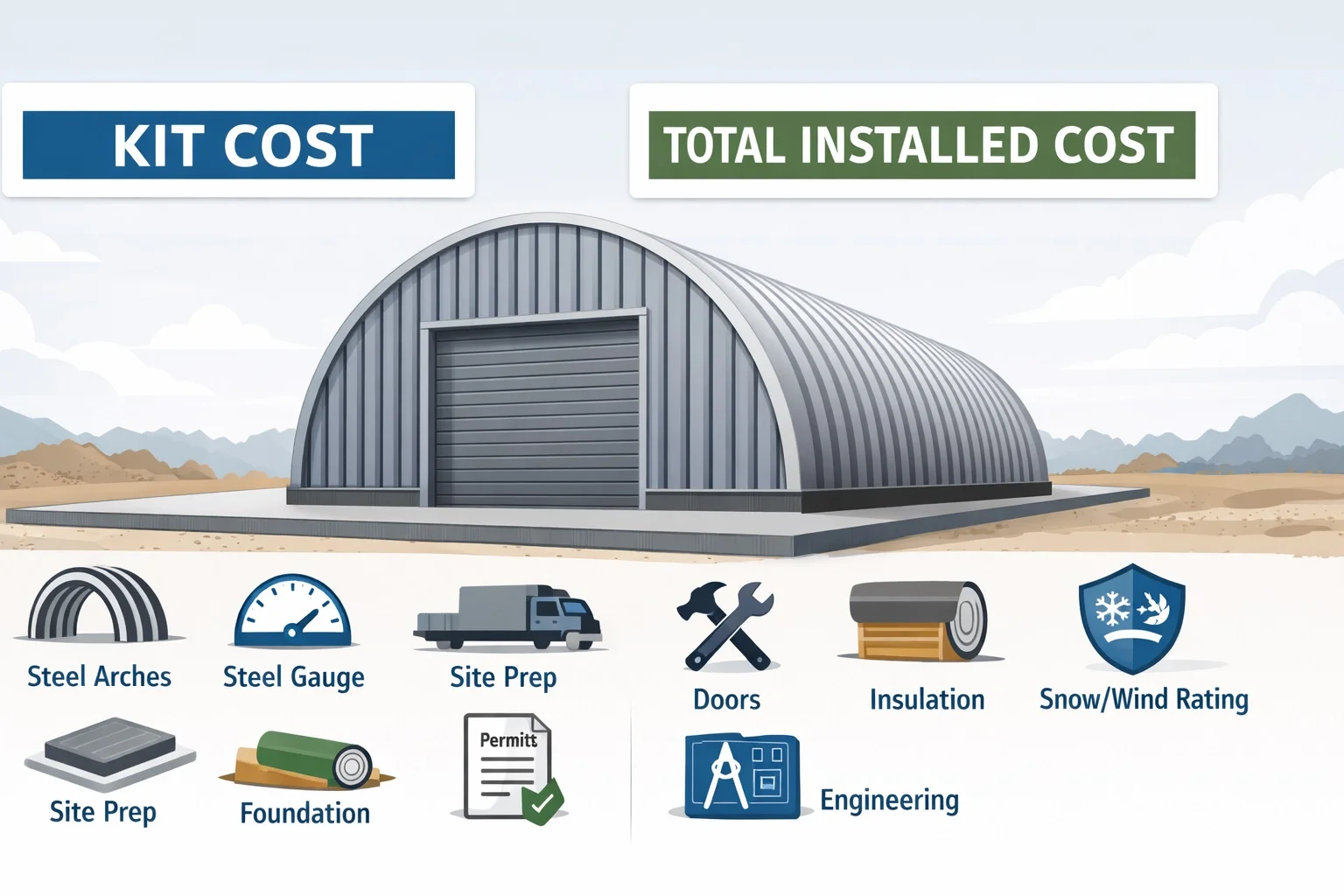
You may have come across Quonset huts while browsing steel arch buildings online. These huts are quite popular due to their affordability. However, Quonset huts come priced at a large range due to many different factors; understand Quonset kit pricing factors such as steel thickness, wind/snow load rating, foundation type, level of insulation, and partial vs full completion of the building kits.
In this guide, I present factors that affect Quonset kits, ranges of prices when it comes to building Quonsets, a comparison of building Quonset structures, and practical tips I’ve obtained through my experience working alongside builders and buyers.
As of today, in Quonset buildings, there are two prices that are streamlined into the overall cost of construction. These are the kit cost and the installed total.
The kit contains the Quonset steel arch panels as well as a few extra pieces of construction material and hardware. As a general guideline for pricing Quonset buildings, smaller structures start at what could be deemed manageable prices, while larger buildings cost more due to the increased need for heavy steel and additional foundation engineering.
When viewing the prices for Quonset buildings, a good analogy is to think of it like a menu. The base kit is an app, while the upgrades are like the main course.
For many, the small kit is a good option for personal storage, single vehicle garages, small workshops, and equipment shelters. These small structures can often be shipped, assembled, and permitted in a wide variety of areas more easily than the larger structures.
In my experience, small kit customers often overlook the extras, like insulation and doors. While the steel shell may look affordable, it is often hard to use the interior without proper access. Additionally, a Quonset structure price estimate should ideally be inclusive of one large door and a concrete plan.
Large Quonset kits are great for multi-bay workshops, warehouses, and aircraft hangars, as well as commercial storage and farm operations. These kits need stronger engineering in addition to larger foundation footprints as well as increased snow and wind load requirements.
If you wish to obtain accurate pricing on steel arch buildings, large buildings have specifications that matter the most to the final quote. A small upgrade, such as a thicker gauge steel or higher wind rating, can add a significant amount to the total price, especially when multiplied across a wide roof span.
When comparing the cost of prefabricated Quonset kits, many expect that a large kit is nothing more than a scalable version of a smaller kit. Pricing behavior is different from that of a smaller kit. Here is what typically changes.
The steel is the most expensive component of your total cost. Larger buildings require an increase in the number of panels needed as well as larger dimensions and sometimes an increase in steel gauge thickness for structural integrity.
A thicker gauge steel increases the durability and load bearing capacity of the structure, however, it increases the material cost and shipping weight.
If a location has heavy snow or high winds, the corresponding recommended steel may increase one or more levels to a thicker gauge. That upgrade impacts larger kits more than smaller kits because it affects a greater amount of square footage.
Larger builds will require more in depth engineering drawings, including permits, and code compliance documentation. Most buyers overlook this during the initial budgeting phase, and are later taken aback when the permitting office requires more detailed load specifications or custom foundation plans.
This is one of the more pertinent details in developing an understanding of the contributing factors to pricing of Quonset kits.
Small structures may be placed on compacted slabs or on engineered gravel systems with compliant local regulations. Larger structures almost always require an adequately designed foundation, which is typically a concrete slab with footings or some form of perimeter thickening.
When two kits are compared, installed costs may vary significantly even when the steel prices are the same. This is due to variations in site grading, the plans for site drainage, and the volume of concrete required.
Doors can be a significant hidden cost. One small garage might require one roll-up door and one walk door, whereas a commercial-scale Quonset may require several roll-up doors, taller door openings, and reinforced end walls in total.
Oftentimes, when clients ask why their large kit estimate has increased so significantly, the doors are the answer.
When insulation and ventilation become necessary depends on how you will use the building. With insulation and ventilation, larger structures require a greater surface area of insulation, more ventilation, and improved controls for condensation.
This is why the intended use of a building, beyond the steel shell, should dictate the expected costs of the Quonset hut more than the design (shell) itself.
Below is a simple method of estimating budget implications, for various uses of a Quonset structure.
A small kit intended for basic storage may closely meet the budget of “kit plus foundation and door”. A large kit intended for business use is more likely to exceed the budget of “kit plus engineering, stronger foundation, multiple doors, insulation, and labor”.
In summary, small Quonset structures tend to scale in a predictable manner, while large Quonset structures tend to scale in a way that increases complexity.
In order to avoid excess effort and arrive at a more precise estimate of the costs, use this method for Quonset structures.
Consider what you are going to do inside the building. Operations that require only storage entail a different cost structure than those that require a heated workshop, or involve commercial activities.
You can’t fix later the snow and wind loads without changing the whole kit. That’s why these must be set early so your quote captures the right steel and design.
End-wall framing and total cost are impacted by door size, number, and position. This is one of the fastest ways to keep your pricing predictable.
A Quonset building pricing guide is smart because it always keeps these apart:
Kit cost (includes steel, hardware, and accessories)
Total installation (foundation, labor, doors, insulation, permits)
This simplifies quote comparisons.
An easily avoidable mistake is opting for the cheapest kit and expecting everything else to be minor. This is just one component of the overall budget. Concrete, door upgrades, and code requirements can balloon the final cost.
Oversizing is another mistake. Many people think bigger is always better, but a properly planned medium size structure can outperform an oversized building with weak insulation or limited access.
Evaluating ranges of possible prices for Quonset building kits will show that the better value, in most cases, is the kit that best suits your actual needs, not the one that offers the greatest building span.
When evaluating the costs of small and large prefabricated Quonset kits, keep in mind that the cost of a large kit is not simply the additional square footage. It also adds engineering costs, foundation costs, and necessary upgrades.
Smaller kits are great if you are looking for a straightforward and quick answer. Larger kits will become a more valuable resource if you are thinking of the Quonset as a commercial building, for heavy machinery, or as a multipurpose facility.
To evaluate building prices, understand the factors that contribute to the prices of Quonset kits and how much Quonset kit structures cost, and understand the price ranges for Quonset building kits, you will need to focus on the total value in installation, not just the value in the base kit.
A well thought-out Quonset building is an investment that will pay you back with its longevity, low maintenance, and adaptable space.
The most significant price drivers are often the steel (gauge and load ratings) and foundation requirements, as well as the doors and insulation, depending on your intended use.
Quonset kits can be more affordable, especially for basic storage applications. However, adding insulation, an enclosed interior, and multiple accesses to the unit tends to keep prices in a similar range. An often cited benefit of Quonset structures is their relatively fast assembly.
Building a large Quonset structure does lower the cost per square foot for the kit cost, however, total installed costs for engineering, foundation, and doors can offset that lower kit cost. With good planning large Quonset structures can be more efficient.
Determine the size, the door configuration, and the load ratings of the structure before requesting an estimate that also includes the engineering. Then, obtain an estimate for the local foundation to help you compare final costs.
If you are storing tools, electronics, or items that are damaged by moisture, insulation and vents will help control condensation and moisture. For equipment storage, simple air flow will often be adequate.
Some designs permit future expansions, but this is contingent upon the type of kit and the planning of the foundation. If expansion is a possibility, it is advisable to mention it prior, so the structure can be designed accordingly.