
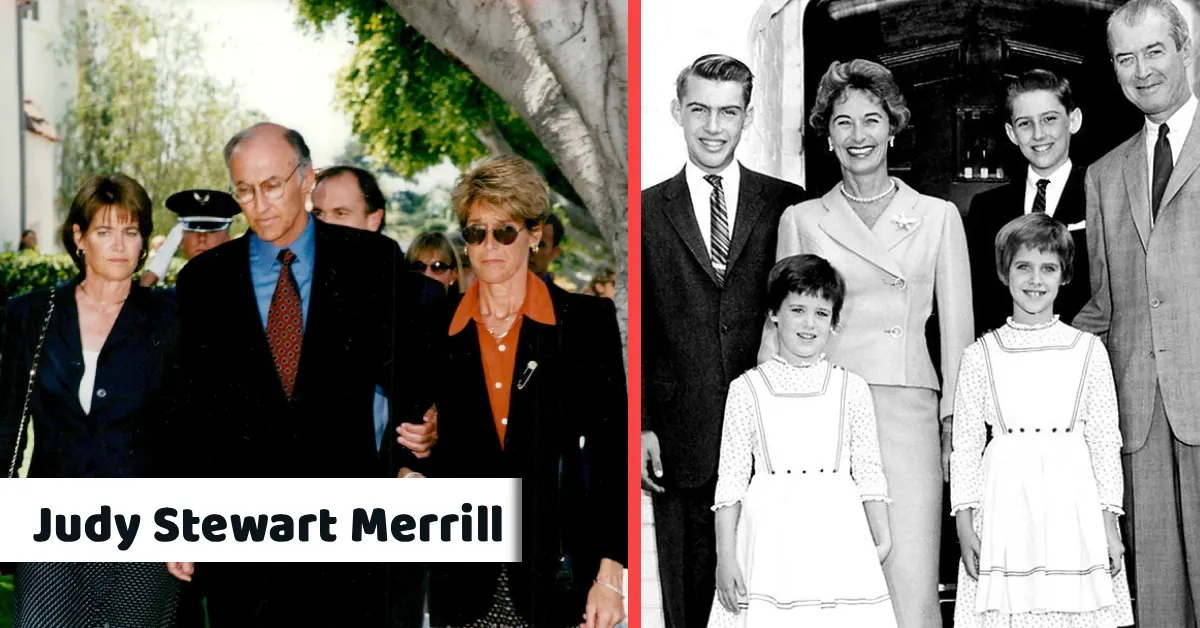
udy Stewart-Merrill, born May 7, 1951, is the twin daughter of legendary actor James Stewart and former model Gloria Hatrick McLean. Unlike many celebrity children, she chose a private life away from Hollywood, focusing on family while her twin sister Kelly pursued primatology and academics.
Who Is Judy Stewart Merrill?
Judy Stewart-Merrill represents a fascinating paradox in Hollywood history. As the daughter of James “Jimmy” Stewart—one of cinema’s most beloved actors—she had every opportunity to pursue stardom. Instead, she chose something rarer in Tinseltown: privacy.
Born on May 7, 1951, in Los Angeles, Judy entered the world alongside her twin sister Kelly, just two years after their father married Gloria Hatrick McLean, a former model and actress. Now 74 years old as of 2025, Judy has spent most of her life deliberately out of the spotlight, married to Steven Merrill with two sons, David and John.
While her father captivated millions on screen with performances in classics like It’s a Wonderful Life, Rear Window, and Vertigo, Judy carved out a different kind of wonderful life—one measured not by box office success but by family bonds and personal authenticity.
Growing Up in Hollywood’s Golden Age
The year Judy and Kelly were born, their parents purchased a home at 918 N. Roxbury Drive in Beverly Hills—an ivy-covered Tudor-style house in the area known as “The Flats,” where the life of Judy began. This would be the Stewart family sanctuary for decades, a place where Hollywood glamour stopped at the front door, especially for the twin daughters, Judy.
Kelly Stewart-Harcourt, Judy’s twin, later recalled in interviews that their father had a remarkable ability to separate his public persona from his family life. James Stewart made a conscious effort to leave his work at the office, rarely discussing films at home. The family would gather in the library around 5:30 p.m. to watch the news together, a ritual that grounded them in real-world events rather than Hollywood gossip.
Unlike some celebrity parents who paraded their children through premieres and parties, James and Gloria prioritized normalcy. Judy and Kelly walked dogs around the neighborhood, skateboarded on quiet streets, and experienced childhood largely protected from their father’s fame. This early foundation shaped Judy’s later decision to maintain that same privacy.
Judy did make a handful of television appearances during her youth and young adulthood, including game shows like Password (1961), The Mike Douglas Show (1961), and V.I.P.-Schaukel (1971). She also appeared as herself in the 2017 documentary James Stewart, Robert Mitchum: The Two Faces of America. However, these were brief ventures into the public eye, not the beginning of a sustained career for the daughter of James Stewart.
The Stewart Family: A Hollywood Dynasty
Father – James Stewart’s Uncommon Legacy
James Maitland Stewart (1908-1997) wasn’t just a movie star; he was an American ideal. With his distinctive drawl and everyman appeal, he embodied authenticity in an industry often criticized for superficiality. His career spanned over five decades with more than 80 films, earning him Academy Award recognition and a place among the greatest actors in American cinema history.
Beyond acting, Stewart served with distinction in World War II as a bomber pilot, eventually rising to the rank of Brigadier General in the Air Force Reserve. He flew combat missions in B-24 Liberators and later observed bombing runs in Vietnam. His military service wasn’t Hollywood publicity—it was a genuine commitment to his country.
As a father, Stewart applied the same values he portrayed on screen: integrity, humility, and dedication. Kelly has shared that while he wasn’t a particularly hands-on father by modern standards, he led by example. He showed his children that character mattered more than celebrity, a principle that resonated deeply in the life of Judy.
Mother – Gloria Hatrick McLean
Gloria Hatrick McLean brought her own grace and intelligence to the Stewart household. Before marrying James in 1949, she had been married to Edward Beale McLean Jr., with whom she had two sons: Ronald and Michael, who were part of the life of Judy Stewart-Merrill. James Stewart adopted both boys after the marriage, creating a blended family that would include four children.
Gloria was admired not just for her beauty—she had been a successful model—but for her compassion and strength. She helped create the nurturing environment that allowed all four children to develop their own identities separate from their famous stepfather’s shadow.
Her death from lung cancer on February 16, 1994, devastated James Stewart. Biographer Donald Dewey described him as “lost at sea” afterward. The man who had brought warmth and optimism to millions through his films became increasingly reclusive, though his children and grandchildren remained sources of comfort.
Siblings: Four Children, Different Paths
Twin Sister Kelly Stewart-Harcourt: The Anthropologist
While Judy chose privacy, her twin Kelly took an entirely different route—though not toward Hollywood. Kelly graduated from Stanford University and earned a Ph.D. from Cambridge University, specializing in anthropology and primatology.
In the 1970s, Kelly worked at the Karisoke Research Center in Rwanda, studying mountain gorillas under the legendary primatologist Dian Fossey, which reflected the adventurous spirit of the Stewart and Gloria Hatrick McLean family. She experienced firsthand the challenges of field research, including an incident where eighteen months of field notes were accidentally destroyed in a cabin fire. Despite setbacks, she persevered and later taught at the University of California, Davis, alongside her husband, Alexander “Sandy” Harcourt, whom she married in 1977.
Kelly has given numerous interviews over the years, sharing memories of their father and offering insights into the Stewart family. In her book contributions and media appearances, she’s explained that watching her father work on film sets convinced her that acting wasn’t appealing. The constant interruptions, the repetitive takes, the fussing over hair and makeup—it all seemed tedious compared to the intellectual freedom of scientific research.
The contrast between the twins is striking: Kelly engaged publicly with her father’s legacy while building her own impressive career, while Judy maintained almost complete privacy. Yet both choices reflect the values James Stewart instilled—following your own path regardless of expectations.
The Tragedy of Ronald McLean
The most painful chapter in the Stewart family story involves Ronald McLean, Judy’s older half-brother. After graduating from college in the mid-1960s, Ronald enlisted in the Marine Corps—a decision his parents supported with pride. James Stewart, himself a decorated military veteran, believed in service to country.
On June 8, 1969, First Lieutenant Ronald Walsh McLean was killed in action during a reconnaissance mission in Quang Tri Province, Vietnam. He was 24 years old and had been with his reconnaissance unit only a few weeks. The patrol was ambushed, and Ronald was shot by a sniper while breaking cover to help a wounded team member. He was posthumously awarded the Silver Star for his courage.
The loss devastated the entire family. In a 1982 interview on Good Morning America, James Stewart broke down when discussing Ronald’s death. “I don’t think there’s a day that goes by that I don’t think of Ron,” he said, his voice cracking with emotion. “He didn’t want to be drafted. He wanted to be a Marine. And I encouraged it… He died for his country.”
This tragedy marked the family deeply. For Judy, who was 18 when Ronald died, it reinforced the understanding that fame and fortune provide no shield against real-world grief, a lesson taught by her devoted father. The Stewart family’s handling of this loss—with dignity and without exploiting it for sympathy—further demonstrates the values that shaped Judy’s approach to life.
Michael Stewart: The Other Half-Brother
Michael Stewart, Ronald’s younger brother, also chose to live away from public attention. Little is documented about his life, consistent with the family’s overall approach to privacy. He has remained out of the spotlight, much like Judy, allowing his famous stepfather’s legacy to stand on its own without using it for personal gain.
Marriage and Family Life
Judy Stewart-Merrill is married to Steven Merrill, and together they have two sons: David Merrill and John Merrill. It’s important to note a common misconception: Judy’s husband is not Stephen E. Merrill, the former governor of New Hampshire who served from 1993 to 1997. Governor Merrill was married to Heather Merrill. This confusion appears repeatedly in online sources but is contradicted by official records and obituaries.
Judy’s family has maintained connections to Northern California, particularly the San Francisco Bay Area. A 1997 news article mentioned James Stewart visiting his daughter, “Judy Merril,l” in areas like Atherton and the Burlingame Club, indicating she had established roots there.
Beyond these basic facts, Judy has successfully kept details of her marriage and children’s lives private. In an era where celebrity children often monetize their family connections through social media and reality television, this restraint is notable. Judy has raised her sons away from the glare of Hollywood, much as her own parents tried to do for her.
Why Judy Chose Privacy Over Fame
Understanding Judy’s choice requires understanding her father. Despite his enormous fame, James Stewart was fundamentally uncomfortable with celebrity. He disliked watching his own films, rarely attended premieres unless contractually obligated, and would only smoke—a rare indulgence—when forced to sit through screenings of his work.
Kelly Stewart-Harcourt shared that their father “left his work at the door.” At home, he was simply Dad, not the Academy Award-winning actor. This modeling taught both twins that identity didn’t have to be tied to public recognition.
Judy witnessed firsthand the tedium and artificiality of Hollywood production, which contrasted sharply with the devoted father she knew at home. While Kelly explicitly stated that watching their father work looked boring, Judy drew similar conclusions without needing to articulate them publicly. The rushed, fragmented nature of filmmaking, the constant attention to appearance, the loss of privacy—none of it appealed.
Moreover, Judy came of age during a transformative period in American culture. The late 1960s and early 1970s saw growing skepticism toward institutions and celebrity worship. Her brother Ronald’s death in Vietnam in 1969, when she was just 18, likely reinforced a desire for substance over superficiality in the life of Judy Stewart-Merrill.
In choosing privacy, Judy wasn’t rejecting her father’s legacy. She was honoring its core message: that character matters more than fame, that integrity is demonstrated in how you live, not how you’re perceived. James Stewart became beloved not because he courted attention but because he embodied authenticity. Judy has done the same, just without cameras recording it.
The Stewart Legacy Today
At 74, Judy Stewart-Merrill continues to live with the quiet dignity that has defined her adult life. While she occasionally appears at tributes and events honoring her father’s memory—there are photographs from various family gatherings over the years—she has never sought to be the story herself.
This restraint becomes more impressive when contrasted with contemporary celebrity culture, where children of famous parents often leverage that connection into personal brands. Reality shows, Instagram influencer status, “nepo baby” debates—none of this seems to interest Judy.
Her sister Kelly, though more public, has similarly focused on her own accomplishments rather than trading on their father’s name. Kelly’s work in primatology and conservation stands on its own merit. When she does discuss their father, it’s with genuine affection and insight, not calculated media strategy.
James Stewart died on July 2, 1997, at age 89, surrounded by his children. Over 3,000 people attended his memorial service. President Bill Clinton called him a “national treasure.” Yet perhaps the truest measure of his legacy isn’t the accolades but the children he raised—each finding their own way to contribute meaningfully to the world.
Judy Stewart-Merrill might not have her father’s name on a Hollywood star, but she carries something more valuable: his values. In a culture obsessed with visibility and validation, she’s chosen instead to focus on what matters when the cameras stop rolling—family, authenticity, and a life lived according to principles rather than publicity.
FAQs
Q: How old is Judy Stewart Merrill?
A: Born on May 7, 1951, Judy Stewart-Merrill is 74 years old as of 2025.
Q: Is Judy Stewart Merrill married?
A: Yes, she is married to Steven Merrill. They have two sons named David Merrill and John Merrill.
Q: Did Judy Stewart Merrill marry the New Hampshire governor?
A: No, this is a common misconception found in various online sources. The former Governor of New Hampshire, Stephen E. Merrill (who served 1993-1997), was married to Heather Merrill, not Judy. Judy’s husband, Steven Merrill, is a different person entirely.
Q: Does Judy Stewart Merrill act like her father?
A: No, Judy chose not to pursue an acting career. She made only a few brief television appearances on game shows like Password and The Mike Douglas Show. During her younger years, as well as appearing in a 2017 documentary about her father, the life of Judy Stewart-Merrill focused on private family life rather than entertainment.
Q: What is Judy Stewart Merrill’s relationship with her twin sister, Kelly, who shared the experience of being the daughter of James Stewart?
A: Judy and Kelly Stewart-Harcourt share a close bond despite choosing different paths. Kelly became an anthropologist and primatologist, working publicly in academia, while Judy maintained a more private lifestyle. Both sisters have occasionally appeared at events honoring their father’s legacy.
Q: What happened to Judy Stewart Merrill’s brother, Ronald?
A: Ronald McLean, Judy’s half-brother, was killed in action in Vietnam on June 8, 1969, at the age of 24. He was serving as a First Lieutenant in the Marine Corps during a reconnaissance mission when he was shot by a sniper. He was posthumously awarded the Silver Star for his bravery.
Q: Where does Judy Stewart Merrill live?
A: While specific current details remain private (consistent with Judy’s lifestyle choice), reports from the late 1990s indicated she had connections to the San Francisco Bay Area in Northern California, including areas like Atherton. She has successfully maintained privacy regarding her exact residence.
Q: What does Judy Stewart Merrill do for a living?
A: Judy’s professional life, if any, has been kept entirely private. Unlike her twin sister Kelly, who pursued a public academic career, Judy has chosen not to share details about any career or professional activities. She appears to have focused primarily on family life.